Brandon Maure
Vainqueur the DragonBrandon Maure is the Demon King of Ishfania and the central power behind a chain of military, political, and magical threats confronting Vainqueur Knightsbane. His decisive significance lies in the contrast between his broad network of agents and resources and the abrupt, humiliating defeats inflicted on him by a dragon who treats imperial authority as a personal license to act.
Identity and Political Position
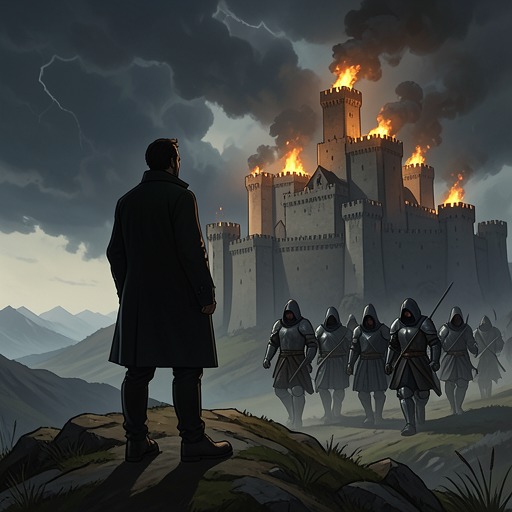
Brandon Maure is identified as the king of Ishfania and as a major demon lord. His authority is not merely ceremonial: he offers asylum and a retirement payment to former Gardemagne raiders in exchange for destructive military service. François Vilmain explains that Maure hired the veterans to burn the countryside of Euskal and keep the crusaders occupied while he retook his fortress of Rochefronde, a campaign that necessarily included the destruction of Haudemer. The arrangement reveals Maure as a ruler willing to outsource warfare to mercenaries whose expertise consists of massacring settlements and torching villages, while presenting the arrangement as a financially attractive retirement.
Maure’s political claim also directly challenges Vainqueur Knightsbane’s rival title. During the arena confrontation, Maure’s spokesman declares that Murmurin is a daughter of Ishfania and that Ishfania has only one king: the king standing before Vainqueur. Maure therefore treats Vainqueur’s imperial claim not as an eccentric private boast but as an intrusion into Ishfanian sovereignty. The conflict is consequently territorial and dynastic as well as personal.
Agents, Schemes, and Forbidden Knowledge
Maure’s influence extends through human soldiers, former wartime raiders, and the lich Furibon. Furibon tells Victor Dalton and Vainqueur that Maure warned him about their role in helping Gardemagne retake Rochefronde, destroying Maure’s chosen agents, and stealing the Apple of Knowledge. Furibon also recognizes that the visitors have already examined the artifact’s forbidden knowledge. This report places Maure behind the pursuit of the stolen object and confirms that he tracks Vainqueur’s activities through an organized chain of servants rather than encountering him by chance.
The same network exposes the vulnerability of Maure’s strategy. His forces repeatedly attack Haudemer, but a dragon guarding the city eats the first attackers and kills the men sent to investigate their disappearance. At the same time, the royal army closes in, leaving Maure’s agents unable to abandon the city without jeopardizing their financial agreement. Maure’s campaign thus depends on expendable intermediaries, yet every failed intermediary increases the pressure on the larger operation.
Maure is also connected to a destructive magical economy. Vainqueur’s expectation of enormous income from defeated demons is interrupted when Furibon uses the spell [Transmute Gold to Lead], turning the coins into lead with black magic. Although the immediate caster is Furibon, the episode belongs to the wider conflict shaped by Maure’s demon forces and the value Maure’s servants represent to Vainqueur. The scene makes Maure’s resources materially unstable: even victory over his agents can be corrupted, redirected, or rendered worthless by the magic surrounding his side.
The Arena Confrontation
Maure’s public image is introduced through spectacle. A fiend commentator announces him as the demonic superstar, the invincible champion, and the undefeated king of Ishfania. He enters through a doorway in the arena wall as a thin, fragile-looking elf with light-purple, nearly gray skin, silver eyes, and short silver hair. His gold-plated garment leaves his chest exposed, a horned silver diadem marks his rank, and he carries both a blade and a red cloth. The crowd responds with cheers and chants of "Maure, best demon!" Fire and white smoke burst from openings in the arena walls, turning his arrival into staged propaganda.
The performance is immediately tied to a record of accumulated injuries. Maure’s representative accuses V&V of repeatedly slighting him: V&V has killed his human minions, stolen his precious apple, destroyed his court magician, and ruined a century of demon-summoning work. Maure’s grievance is therefore presented as a balance sheet of losses rather than a single insult. His demand for restitution is framed as a question of what he has done to deserve such treatment, but Vainqueur answers that Maure’s mere existence in Vainqueur’s world is sufficient reason for hostility. Their exchange strips away diplomatic justification and exposes an irreconcilable struggle over who has the right to define the world around them.
Defeat and Collapse of Authority
Maure initially remains dangerous because he possesses resources beyond his personal combat ability. During the aerial battle aboard the Iron Eagle, he orders attacks from the flying fortress and rejoices when he believes Vainqueur has died. He then commands his forces to carpet the ground and destroy an ugly village as well, extending the attack from the immediate duel to indiscriminate devastation. The order confirms that his power is exercised through mass violence and that civilian destruction is an ordinary instrument of his campaign.
Vainqueur survives by combining concealment and timing. After deactivating Spell Purge, he uses the Ring of Invisibility while the cloud still conceals him, catches up to the Iron Eagle, and attacks from above with a fireball. The blast destroys a large part of the flying fortress and throws Maure onto its left wing, leaving half of the demon king’s body burned to a crisp. Maure protests that Vainqueur attacked while invisible, treating the tactic as dishonorable even though the battle itself has been conducted through bombardment, minions, and overwhelming force. Vainqueur answers that he is intelligent enough not to give Maure another chance to run around, emphasizing that stealth has defeated a ruler whose strength normally depends on distance and support.
Maure still claims that he has resources and friends in low places and promises to return. The claim lasts only through his speech. Vainqueur, now under the Berserk status and moving faster than before, interrupts the rant by poking Maure in the middle of it. The impact crushes him like an insect; when Vainqueur lifts his finger, only a bloody smear remains on the metal. Maure’s final defeat is therefore not a ceremonial overthrow but a grotesquely compressed reversal of his public image: the undefeated champion becomes something small enough to be erased by a single finger.
Narrative Function and Significance
Brandon Maure functions as both a political antagonist and a theatrical shadow of Vainqueur. He claims kingship through territory, armies, contracts, relics, magicians, and public acclamation, while Vainqueur claims emperorship through assertion and repeatedly validates the claim by force. Maure’s elaborate presentation, including the diadem, red cloth, cheering audience, fire, and smoke, constructs an aura of invincibility that the later combat dismantles piece by piece.
His arc also follows the book’s game-like logic of accumulated consequences. Maure’s human minions are killed, his Apple of Knowledge is stolen, his court magician is destroyed, and a century of demon summoning is said to have been ruined before Maure personally appears. When Vainqueur finally punches him into temporary retreat, the system rewards the act with levels in Gladiator and Kaiser, along with the Victory Fist and Summon Herald (Victor Dalton) Perks. Maure’s defeat thus produces not only a political reversal but measurable advancement for his enemy.
The character’s final image is deliberately at odds with his title. The Demon King of Ishfania enters as an adored champion and exits as a smear on the Iron Eagle’s metal. His repeated reliance on agents and hidden resources cannot withstand Vainqueur’s refusal to recognize his sovereignty, and his promised return is cut off before it can become another campaign. Maure remains significant because the story uses him to expose the instability beneath grand titles: a kingdom, an army, and an undefeated reputation can all collapse in the instant between a threat and a punch.